Key Facts from This Era
- •A Name on the City's List
- •Putting the Rooms Back
- •The Story That Was Added
For a long stretch I was a house of keys. Different locks, different hours, a stairwell that never carried one family's rhythm from the bottom of me to the top. Then the locks came out. Someone crossed the third floor at midnight and kept walking, and nothing behind any door was a separate address.
A Name on the City's List
On February 8, 1995, 1822 Pine Street went onto the Philadelphia Register of Historic Places — not alone, and that is the whole point of it. It entered as a contributing property of the Rittenhouse-Fitler Residential Historic District, one brick in a longer argument about what this stretch of the city is; the federal district around Rittenhouse Square had been listed a dozen years earlier. The City's own inventory described the south side of Pine in the flattest possible terms: nineteen four-story, two-bay brick houses, late Greek Revival, built to match. A house that was never meant to be singular had finally been counted.
Some things about it had not moved at all. The ground is described the same way in 1854 and in the parcel record today: the south side of Pine, two hundred and thirty feet west of Eighteenth, twenty-two feet across the front, ninety feet deep, running back to Waverly Street. Not an inch of difference in a hundred and seventy years.
Twenty-two feet is not much of a front. Everything this house has ever done, it has done in depth.
Putting the Rooms Back
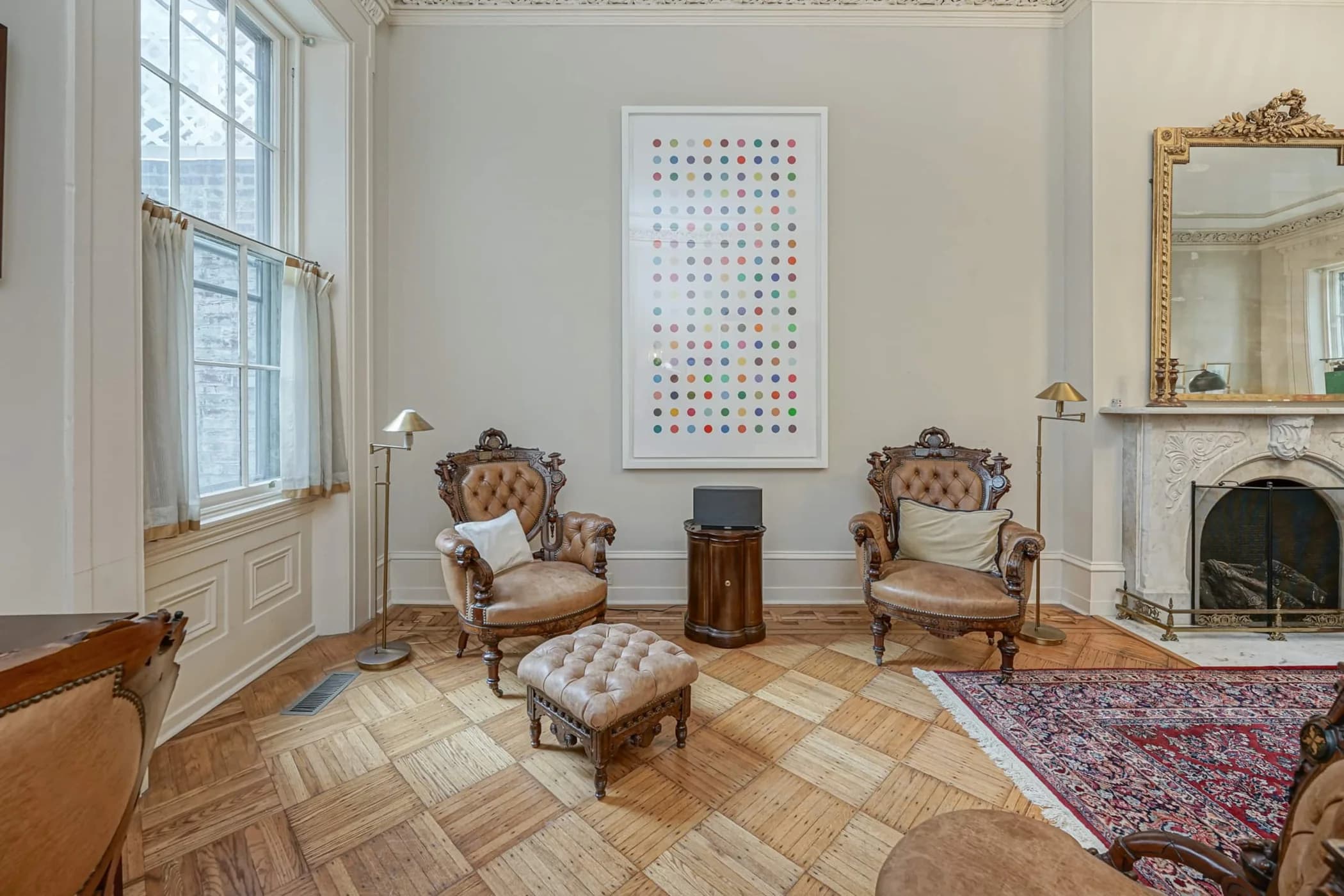
The reassembly took a generation. The city's land-use plates still marked this address as multiple family into the 1960s, and the deeds came fast through the middle of the century and kept coming after it, one owner handing it on to the next. Somewhere across those transfers the partitions came down. The pocket doors between the two parlors slide again. The plasterwork stayed; the mantels stayed; the kitchens and the bathrooms did not, and were rebuilt for people who expect hot water at seven in the morning.
The top of me is younger than the rest and has never quite forgotten it. Newer joists, newer plaster, a floor that arrived late to the argument. Above that, sky. A house that gains a whole story at forty-five learns not to be precious about its edges.
The Story That Was Added
That fifth floor is the reason the roof is worth standing on. A widow put it there in two summers at the turn of the century, over a house that had been sold at auction as four stories, and the roof deck people use now — skyline in front of them, chimney pots below — sits directly on top of her ambition. She built it to hold rooms. It ended up holding the view.
Lights in Every Window
Consider who has come over this step. A merchant who bought the ground in 1854, lived here four years, and let it to tenants for the rest of his life; his estate went on letting it for another twenty-three. A man who made a fortune out of white clay and moved his household in from across the river. A widow who buried her husband's son out of the front room and then added a floor. A mother and her daughters who published which afternoons the door would open — and one of those daughters, twenty years later, selling suffrage tickets from the hall table at a dollar fifty apiece. A household that advertised for a chambermaid one Monday in May, wanted only until the first of June.
Not tonight. Tonight there are guests around the ten-seat dining table and others eating elsewhere in the house, and the noise comes up the stairwell in waves — loud, then a lull, then louder. Somebody is on the roof in a coat. Somebody has fallen asleep on the fourth floor with the lamp on. Every window on the front of me is lit, which almost never happened in a hundred and seventy years, and I have stopped pretending I do not prefer it.