Rittenhouse Square Guide · Sourced from the Association for Public Art
The public art of Rittenhouse Square.
Eight works of art live in the Square — a French Romantic lion, a fountain girl who spent four years lost in storage, a goat polished gold by a century of children, and a memorial hiding on the back of the fountain. Their stories are scattered across a half-dozen websites; this page collects all eight, dated and sourced, in the order they were made.
1832
Lion Crushing a Serpent
Antoine-Louis Barye (1796–1875)
1911
Duck Girl
Paul Manship (1885–1966)
1914
Billy
Albert Laessle (1877–1954)
1922
Dr. J. William White Memorial
R. Tait McKenzie (1867–1938) with Paul Philippe Cret
1941
Giant Frog
Cornelia Van Auken Chapin (1893–1972)
1947
Evelyn Taylor Price Memorial Sundial
Beatrice Fenton (1887–1983)
1988
Greyhound Sculptures
Artist unknown
2010
Gardener's Cottage Gates
Eric Berg
Modeled 1832 · cast 1891 · installed 1892
Lion Crushing a Serpent
Antoine-Louis Barye (1796–1875)
Center of the Square, near the main plaza
The Square's oldest resident is a French Romantic bronze: Barye's lion pinning a serpent, modeled in 1832 — the lion of monarchy crushing the serpent of evil, symbolism that won the approval of King Louis-Philippe himself.
Philadelphians bought their cast the civic way: subscription books circulated from 1885, payment was made six years later, and the bronze was installed in 1892 — the first sculpture placed in Rittenhouse Square.
Created 1911 · in the Square since 1960
Duck Girl
Paul Manship (1885–1966)
The Children's Pool
Manship modeled this bronze of a girl carrying a duck in 1911, early in the career that would later produce Rockefeller Center's Prometheus. Exhibited at the Pennsylvania Academy of the Fine Arts in 1914, it won the Academy's Widener Gold Medal.
Her path to the Square was not direct: placed in Germantown's Cloverly Park in 1916, she was damaged and moved into storage in 1956, then rescued and relocated to Rittenhouse Square's Children's Pool in 1960 — a lost-and-found story hiding in plain sight.
Modeled 1914 · installed 1919 · recast 2018
Billy
Albert Laessle (1877–1954)
In the Square — finding him is half the fun
The Square's most-touched artwork: Laessle's billy goat, modeled in 1914 and installed in 1919 as a gift of Eli Kirk Price II through the Fairmount Park Art Association.
A century of children climbing on his back polished the bronze to gold and wore him thin — so in 2018 Billy was recast, and the new casting carries on the tradition. If you see a child on a goat, you have found him.
Created 1922
Dr. J. William White Memorial
R. Tait McKenzie (1867–1938) with Paul Philippe Cret
On the reverse of the Cret fountain, central plaza
The Square's easiest artwork to miss: a bronze relief by the sculptor R. Tait McKenzie, designed with Paul Philippe Cret and set into the back of Cret's own fountain in 1922.
It honors Dr. J. William White, a founding member of the Rittenhouse Square Improvement Association, and was commissioned by the Flower Market Association — the Square's civic circle memorializing one of its own, on the centerpiece he helped bring into being.
Carved and installed 1941
Giant Frog
Cornelia Van Auken Chapin (1893–1972)
In the Square, near the walks
Chapin, a sculptor known for her animal subjects, carved the frog in granite; the Rittenhouse Square Improvement Association gave it to the city in 1941.
Like Billy, the frog has become a children's mount; its granite back is worn smooth from eight decades of climbing.
Created 1947
Evelyn Taylor Price Memorial Sundial
Beatrice Fenton (1887–1983)
Along the northeast walkway
Two bronze children hold aloft a sundial shaped like a sunflower head — Fenton's memorial to Evelyn Taylor Price, president of the Rittenhouse Square Improvement Association and long-time president of the Flower Market Association.
Commissioned by the Improvement Association and placed in 1947, shortly after Price's death, it ties the Square's art directly to the women who ran its civic life — the same tradition as the Flower Market itself, held here since 1914.
Donated 1988
Greyhound Sculptures
Artist unknown
Southwest entrance pillars
The pair of cast-stone greyhounds guarding the southwest gate were presented in 1988 by friends of the late Henry P. McIlhenny — the Philadelphia Museum of Art curator, collector, and longtime Rittenhouse Square resident, who had died two years earlier.
They are the Square's quietest artwork: most people walk between them without noticing. Now you will.
Created 2010
Gardener's Cottage Gates
Eric Berg
The Gardener's Cottage
The Square's newest work: Eric Berg's gates for the Gardener's Cottage, commissioned by the Friends of Rittenhouse Square as a memorial to longtime board member and resident Patty Hogan.
From subscription books in 1885 to memorial gates in 2010, every work in the Square arrived the same way — given by the people who use it.
The Setting Itself
The artworks live inside a designed artwork: Paul Cret's 1913 plan — the entrances, the balustrades, the central plaza and reflecting pool — still frames the Square today.
Read the full history of the SquareSources
Where these facts come from.
Where the history on this page comes from. If we have something wrong, tell us and we will put it right.
- 1Association for Public Art — Around Rittenhouse Square
The aPA tour documenting all eight works at the Square — the completeness check for this page.
- 2Association for Public Art — Lion Crushing a Serpent
Barye, modeled 1832, cast 1891, installed 1892 — the first sculpture in the Square.
- 3Association for Public Art — Duck Girl
Manship, 1911; Widener Gold Medal 1914; Cloverly Park 1916; storage 1956; Rittenhouse Square 1960.
- 4Association for Public Art — Billy
Laessle, 1914; installed 1919; recast 2018.
- 5Association for Public Art — Dr. J. William White Memorial
McKenzie with Cret, 1922; on the reverse of the fountain; commissioned by the Flower Market Association.
- 6Association for Public Art — Giant Frog
Chapin, granite, 1941; gift of the Rittenhouse Square Improvement Association.
- 7Association for Public Art — Evelyn Taylor Price Memorial Sundial
Fenton, 1947; commissioned by the Rittenhouse Square Improvement Association.
- 8Association for Public Art — Greyhound Sculptures
Cast stone; donated 1988 by friends of the late Henry P. McIlhenny.
- 9The Cultural Landscape Foundation — Rittenhouse Square
Cret's plaza, reflecting pool, urns, and balustrades — the designed setting; the sundial's northeast-walkway placement.
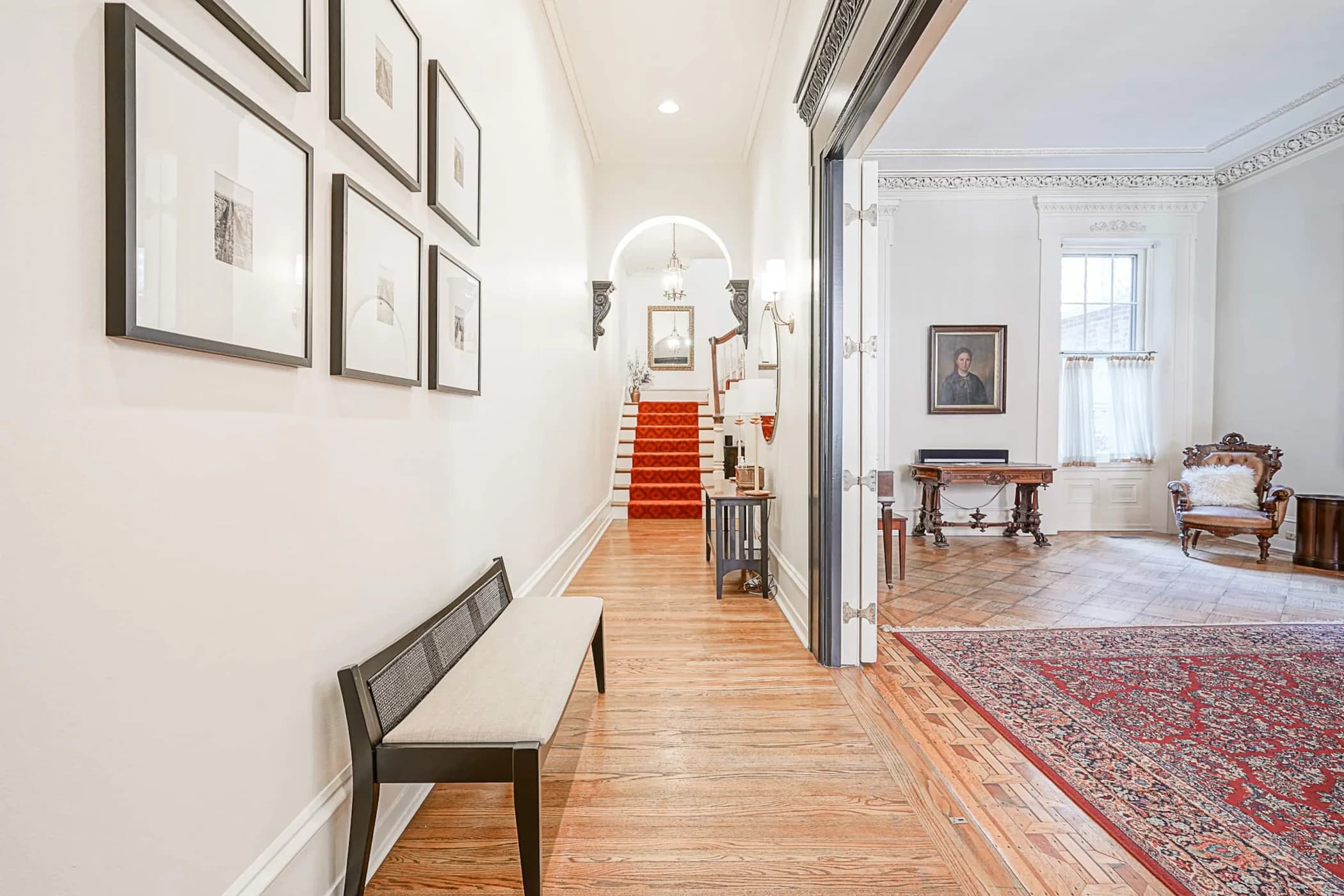
From Two Blocks Away
Sculpture hunt first, dinner after.
All eight works are a two-block walk from The Rittenhouse Residence. Send the kids to find Billy and the frog; the house's own 8 bedrooms and three shared living rooms are waiting when the hunt is over.
Keep Reading
More from the Rittenhouse Square guide.
Rittenhouse Square
What the Square is, how the park and the neighborhood fit together, and how to use both.
Read the pageHistory of Rittenhouse Square
From Southwest Square in Penn's 1683 plan to Paul Cret's 1913 redesign — with sources.
Read the pageThings to Do in Rittenhouse Square
The park's annual traditions, the blocks around it, and what fits a morning versus a full day.
Read the pageRittenhouse Square Restaurants
The tables on and facing the Square, and where locals actually walk one block to eat.
Read the pagePhiladelphia Events Calendar
Conventions, festivals, and the dates that book out the city.
Read the pageWhere to Stay Near Rittenhouse Square
The hotels on the Square, what each does well, and the whole-house option for groups.
Read the page