Rittenhouse Square Guide · Every Claim Cited

The history of Rittenhouse Square.

The square's story is usually told in fragments — a paragraph on a tourism site here, a plaque there. This page assembles the documented timeline in one place, from the Governor's Woods to Paul Cret's plan to last year's news, with a numbered source for every claim. We publish history the same way two blocks south, where our own house's archive holds 63 primary documents.

Five

open squares in Penn & Holme's original city plan

1825

renamed by City Council for David Rittenhouse

1913

Paul Philippe Cret's redesign — largely intact today

1981

listed on the National Register of Historic Places

The Name

Which Rittenhouse? A short disambiguation.

The square honors David Rittenhouse (1732–1796) — astronomer, mathematician, and maker of scientific instruments, appointed by George Washington as the first director of the United States Mint. City Councils gave his name to the old Southwest Square in 1825, three decades after his death.

He was the great-grandson of William Rittenhouse, who in 1690 built the first paper mill in British North America on a Germantown creek — the settlement survives as Historic RittenhouseTown, up the Wissahickon in Germantown, a different place from the square that borrows the family name. And the luxury hotel on the square's west side is named after the square, not the other way around. One family name, three different places.
The Timeline

Three and a half centuries, documented.

Numbers after each entry point to the source list at the bottom of this page.

1682–83

One of Penn's five squares

William Penn and Surveyor-General Thomas Holme lay out Philadelphia's grid with five open squares — drawn in their 1682 “Portraiture,” published on Holme's map in 1683. The southwest square is the future Rittenhouse Square.

Sources: 1, 4

1700s

The Governor's Woods

Through most of the eighteenth century the southwest square sits in dense woods known as the Governor's Woods — cleared in the years leading up to American independence.

Sources: 2

1816

The first improvements

Neighboring residents begin improving the square — lawns are planted and a wooden fence goes up to keep out grazing animals.

Sources: 2

1825

Southwest Square becomes Rittenhouse Square

City Councils rename the square to honor David Rittenhouse — astronomer, instrument maker, and first director of the United States Mint.

Sources: 1, 2, 3

1840

The first house on the Square

The first house facing the square is erected, opening the residential era that will make this one of Philadelphia's most coveted Victorian addresses.

Sources: 5

1854

Two blocks south, a townhouse is sold

The newly built row house at 1822 Pine Street — the house that publishes this page — is sold to merchant John Roset. Its deed chain, published in our archive, runs unbroken from that sale to today. See the chain of title

Source: the 1822 Pine document archive

1857–59

Church of the Holy Trinity rises

John Notman's brownstone church goes up on the square's northwest corner: cornerstone 1857, first services March 1859. Nine years later its rector, Phillips Brooks, writes “O Little Town of Bethlehem” for the church's Sunday School, set to music by organist Lewis Redner.

Sources: 10

1892

The first sculpture arrives

Barye's Lion Crushing a Serpent — bought by public subscription — is installed: the first sculpture in the square.

Sources: 8

1897–98

One of the grandest mansions

Sarah Drexel Fell commissions Peabody & Stearns to build the mansion at 18th & Walnut; she moves in by 1898 with her new husband, Alexander Van Rensselaer. The Fell–Van Rensselaer House still anchors that corner.

Sources: 15

By 1900

America's drawing room

Some of America's most prominent families keep primary residences on the square — the peak of its Victorian aristocracy.

Sources: 2

1913

Paul Cret redraws the square

The newly formed Rittenhouse Square Improvement Association commissions architect Paul Philippe Cret, fresh from the Benjamin Franklin Parkway, to redesign the six-acre square. His entrances, central plaza, stone balustrades, reflecting pool, and fountain remain largely unchanged today.

Sources: 2, 4, 5

May 20, 1914

The first Flower Market

A century-spanning tradition begins: the first Flower Market raises $1,250 each for The Children's Hospital, the Hope Day Nursery, and the Improvement Association.

Sources: 3

May 1914

Pennsylvania's first suffrage demonstration

Philadelphia's suffrage societies hold the state's first suffrage demonstration in Rittenhouse Square before marching to Washington Square. The movement had an address two blocks south, too — see the suffrage record of 1822 Pine Street. Read that record

Sources: 9

1915–1926

The Art Alliance comes to the square

Christine Wetherill Stevenson founds the Philadelphia Art Alliance in 1915; in 1926 it moves into the Wetherill family's 1906 mansion at 18th and Manning Streets, across from the square's southeast corner.

Sources: 16

Oct 13, 1924

Curtis Institute opens

Mary Louise Curtis Bok founds the Curtis Institute of Music in three historic mansions on the square — and a century later, the conservatory is still there.

Sources: 11

1950

The collector on the square

Henry P. McIlhenny — Philadelphia Museum of Art curator and later board chairman — buys 1914 Rittenhouse Square, filling it with one of the era's great private collections. After the Second World War, the square's mansions increasingly give way to high-rise living.

Sources: 2, 13

1976

The Friends are founded

Following renovations for the Bicentennial, the Friends of Rittenhouse Square is established as the park's nonprofit steward, working with Philadelphia Parks & Recreation — the Improvement Association's modern successor.

Sources: 2

1981–1995

Onto the registers

The square is listed on the National Register of Historic Places in 1981. The surrounding Rittenhouse–Fitler Residential Historic District follows: National Register 1983, Philadelphia Register February 1995 — 1822 Pine Street is a contributing property.

Sources: 4, 12

2025

The square keeps evolving

After the University of the Arts' 2024 closure, the Curtis Institute buys the Art Alliance building at auction for $7.6 million — the square's institutions still trading places a century on.

Sources: 14

May 1914

“…many of the city's suffrage societies, including the Men's League, held the state's first suffrage demonstration in Rittenhouse Square…”

Encyclopedia of Greater Philadelphia

Five months earlier, a resident of 1822 Pine Street — two blocks south — had lent her name to the suffragists' tax-resistance campaign, and a year later the Equal Franchise Society's treasurer was selling luncheon tickets from the same address. The movement that marched in the Square lived on these blocks.

The suffrage record of 1822 Pine Street

The Cret Plan

Why the square still works.

Nearly everything you touch in Rittenhouse Square today — the corner entrances, the diagonal walks, the stone balustrades, the central plaza with its reflecting pool and fountain — comes from one commission: in 1913, the newly formed Rittenhouse Square Improvement Association hired Paul Philippe Cret, the French-born architect fresh from planning the Benjamin Franklin Parkway, to redesign the six-acre square.

The Cultural Landscape Foundation notes that apart from small alterations, Cret's design remains intact — which makes the square a rare thing: a great American public space still running on its original 1913 operating system. The sculptures arrived one by one to furnish it; their stories have a page of their own.

Sources

Where these facts come from.

Every historical claim on this page traces to the sources below. If you find an error, tell us and we will correct it.

  1. 1
    Encyclopedia of Greater Philadelphia — Public Parks

    Penn & Holme's 1682 “Portraiture,” the five original squares, and the 1825 renamings.

  2. 2
    Friends of Rittenhouse Square — Our History

    Governor's Woods, the 1816 improvements, the 1825 renaming, the 1913 Cret commission, and the Friends' founding after 1976.

  3. 3
    Pennsylvania Center for the Book — “The Galvanizing Garden”

    Penn State's essay: the Southwest Square renaming and the first Flower Market, May 20, 1914.

  4. 4
    The Cultural Landscape Foundation — Rittenhouse Square

    Southwest Square in 1682; the Improvement Association and Cret; the plaza, pool, and balustrades; 1981 National Register listing.

  5. 5
    ushistory.org — Rittenhouse Square Walking Tour

    The first house facing the square (1840) and Cret's entrances, plaza, railings, pool, and fountain.

  6. 6
    American National Biography — David Rittenhouse

    “Rittenhouse, David (1732–1796), astronomer, mathematician, and maker of mathematical instruments.”

  7. 7
    Historic RittenhouseTown / PHMC marker

    William Rittenhouse's 1690 mill in Germantown — the first paper mill in British North America — and David's birthplace.

  8. 8
    Association for Public Art — Lion Crushing a Serpent

    Cast 1891, installed 1892: the first sculpture in the square.

  9. 9
    Encyclopedia of Greater Philadelphia — Woman Suffrage

    “…held the state's first suffrage demonstration in Rittenhouse Square before marching on Market Street to Washington Square.” (May 1914)

  10. 10
    Church of the Holy Trinity — History

    Cornerstone 1857, first services March 1859, architect John Notman; the 1868 carol per the Encyclopedia of Greater Philadelphia.

  11. 11
    Curtis Institute of Music — History

    Opened October 13, 1924; founded by Mary Louise Curtis Bok in three mansions on the square.

  12. 12
    Hidden City Philadelphia — Rittenhouse–Fitler at 30

    District boundaries; National Register 1983; Philadelphia Register February 1995.

  13. 13
    Philadelphia Museum of Art Archives — Henry P. McIlhenny

    McIlhenny's 1950 purchase of 1914 Rittenhouse Square; curator for 25 years, board chairman from 1976.

  14. 14
    Higher Ed Dive — UArts bankruptcy auction

    The Curtis Institute's $7.6M purchase of the Art Alliance building, January 2025.

  15. 15
    The Philadelphia Inquirer — 1801 Walnut Street

    The Fell–Van Rensselaer House: commissioned 1897 by Sarah Drexel Fell, Peabody & Stearns; occupied 1898.

  16. 16
    CraftNOW Philadelphia — The Philadelphia Art Alliance

    Founded 1915 by Christine Wetherill Stevenson; moved into the 1906 Wetherill mansion in 1926.

Primary Sources, Two Blocks South

We do this for our own house, too.

The same discipline behind this timeline — publish the record, cite the source, say plainly what isn't known — built the archive of 1822 Pine Street: 63 deeds, clippings, and documents from 1854 to today, free to read.

Corrections welcome

If you find an error on this page — a date, a name, an attribution — tell us and we will check the source and fix it. That's the deal we make with every page of history we publish.

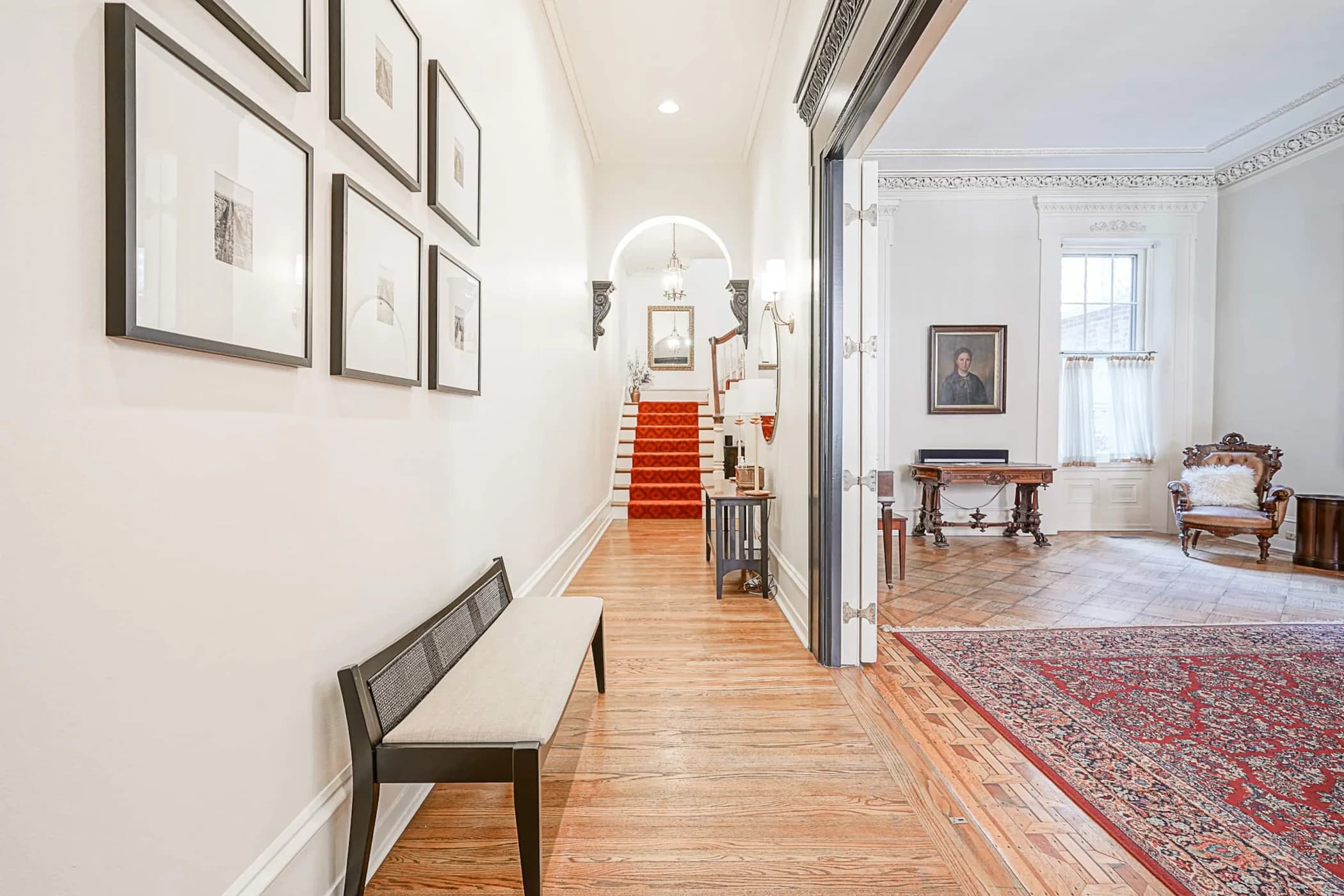
Interior of The Rittenhouse Residence at 1822 Pine Street, two blocks from Rittenhouse Square

From 1822 Pine Street

Stay two blocks from the Square.

This guide is written from 1822 Pine Street — an 8-bedroom historic house two blocks south of Rittenhouse Square that hosts groups of up to 16. The neighborhood in these pages is our daily walk.