Key Facts from This Era
- •The Hall and the Card Tray
- •Pocket Doors and a Large Dining Table
- •The Back Stairs
I am the cold part of the doorway, the piece nobody looks at. Feet tell me everything. Slow means sorrow. Quick means a party already running late. Come in. I will lend you the order the callers used.
The Hall and the Card Tray
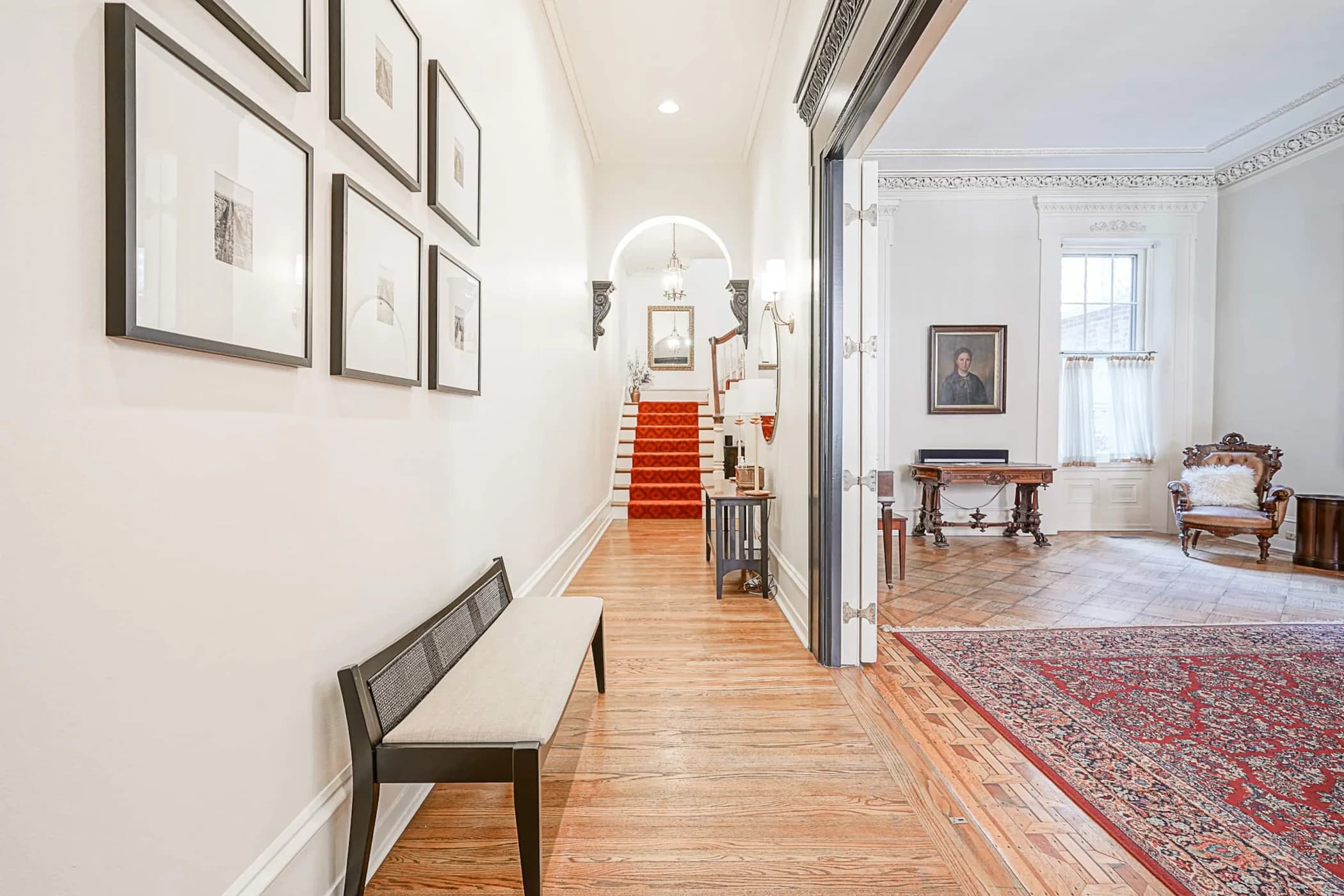
The vestibule is narrow on purpose: two doors an arm's length apart, so winter never got past the second one. Beyond them the hall runs back along the western wall, dim at midday, gold at four o'clock, the stair rising out of it like a held note. On a table here callers left cards — and a generation later, in the winter of 1915, a daughter of the house sold suffrage luncheon tickets across the same table at a dollar and a half apiece.
The big room on this floor now holds a pool table, green under low light, cues racked where a pier glass would have hung. Stand at its far end and you are standing where the chairs were set on a Tuesday morning in November 1896, when the funeral of Graham Spencer went out through this door at eleven o'clock — a man of forty-four whose family fortune came out of white clay, and whose father had bought this address at auction three years before.
Draw the pocket doors out of the wall and you have two rooms. Roll them away and you have the whole house.
Pocket Doors and a Large Dining Table
The double parlors are one room with a seam in it. A front for receiving, a back for staying — or no seam at all, which is what a hostess wanted by nine in the evening. Marble mantels anchor both ends, and one of the fireboxes was cut in one August for a hundred and thirty dollars, on the order of a man the record names and nothing else explains.
Dining sits where the light arrives sideways, off the narrow slot along the western party line that every atlas has drawn since 1885. A large dining table anchors the room. In November 1901 a wedding breakfast was served here after a ceremony at St. James's, at the residence of the bride's parents. The table has been doing that ever since, in one form or another.
Furniture comes in through me one way and goes out the other, and I can tell which by the pauses. Party chairs arrive in a rush and get set down twice. Either way the door stands open longer than the weather likes, and I take the cold for both.
The Back Stairs
The library is the quiet room — books, low chairs, a wet bar doing with ice and glass what a decanter tray once did with more ceremony. Behind it the service stair turns tight and plain, treads worn smooth, invisible from the front hall. Somebody was asked to climb it on a Monday morning in May 1917, to be looked at for a place that ended on the first of June. The Davis years close a year later — suddenly, the notice says, at this address, with the funeral private.
The Story Agnes Added
Bedrooms fill floors two through four, and the windows are the argument for each one. The front rooms take Pine Street whole: tall sashes, deep sills, the particular clean morning light that comes off the brick wall across the way — a wall a Drexel was living behind by 1867, a few doors up the opposite side. Choose a back bedroom instead and you get the other thing: silence, and a stairwell at two in the morning that carries every footstep like a rumor.
The top of the house owes its shape to a widow with ladders up in 1899 and again the autumn after. Above it, the roof deck: chimney pots, slate, the backs of a whole block of houses built in one speculative gesture, and two blocks north the trees of Rittenhouse Square going dark before the streets do. Nobody in 1899 stood up here for pleasure. Somebody does now, most evenings, with a glass.
They come down eventually, all of them, and pass over me on the way out — later than they meant to, quieter than they arrived, one of them carrying shoes. I have felt brides hesitate here and mourners hurry. I only notice that the ones who stayed a few nights step down differently than the ones who merely called: slower, and looking back at the door.